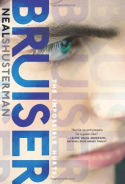
 From the back cover:
Tennyson:
Don’t get me started on the Bruiser. He was voted “Most Likely to Get the Death Penalty” by the entire school. He’s the kid no one knows, no one talks to, and everyone hears disturbing rumors about. So why is my sister, Brontë, dating him? One of these days she’s going to take in the wrong stray dog, and it’s not going to end well.
Brontë:
My brother has no right to talk about Brewster that way—no right to threaten him. There’s a reason why Brewster can’t have friends—why he can’t care about too many people. Because when he cares about you, things start to happen. Impossible things that can’t be explained. I know, because they’re happening to me.
Review:
Let me just state upfront that any parents pretentious enough to name their children Tennyson and Brontë need a damn good whacking.
Moving on, Bruiser (from the author of Unwind) is the story of a social outcast named Brewster Rawlins who is perceived as a creepy delinquent by his classmates but is actually harboring a secret that compels him to keep his distance: if he cares about someone, he will absorb their pain, both mental and physical. Alternating between the perspectives of four characters (broody poetry fan Brewster, twins Tennyson and Brontë Sternberger, and Brewster’s daredevil little brother), the novel depicts how Brewster’s gift/curse affects his relationships with others and how, ultimately, being healed of all one’s ills is not necessarily a good thing.
Initially, Tennyson is opposed to his sister dating Brewster and sets out to warn the guy off, but once he catches a glimpse of Brewster’s terribly scarred back, he begins to suspect something awful is going on at the boy’s home. Concern and conscience win out, and he and Brewster begin to become friends, which is when Tennyson first notices that the scabs on his knuckles (a lacrosse injury) have miraculously disappeared in Brew’s presence. It takes a while for the specifics of his ability to come to light, and an interminable time for Tennyson and Brontë to realize that Brew’s ability to take away pain also extends to their feelings.
At first, I thought they did realize that Brew could quell mental anguish, and that that was part of the reason they convinced/manipulated their on-the-verge-of-divorce parents into taking temporary custody of Brew and his brother, Cody, after their guardian, Uncle Hoyt, passes away. Selfish to use Brew in this way, yes, but believably so for desperate teens. Eventually, though, it seems they really did not know, which is why Brontë kept pushing and pushing for Brew to make new friends, never considering that, for him, more people to care about means more potential injury. Uncle Hoyt was an abusive drunken bastard, true, but his ability to hang on to his own anger (instead of passing it off to Brew) and his insistence that Brew keep his distance from the world are seen in a new light by the novel’s end. (And speaking of the end, reports of its cheesiness are not exaggerated. The last few lines made me go “Pfft.”)
Even with the mystery of Brewster’s powers, Bruiser lacks the high-impact concept of Unwind. Instead of an epic dystopia where the whole country is going in a bizarre direction, Tennyson and Brontë’s world is defined by their home life, where they can tell that something very wrong is happening between their parents. Brew’s presence in their home acts as a balm for a while, but eventually they want to own their own pain because it seems so wrong to feel content while their family crumbles. The novel may not be as dramatic as Unwind, but is possessed of its own subtle themes and messages. I’ll definitely be reading more Shusterman in the future.
well im reading this book for school and it sounds superb so far, im only on page 99 but honestly i dont agree with your statement that whoever named their children bronte and tennyson need a “damn good whacking” . i like unique names and i think its quite wonderful that their mum and dad came up with such excellent names , well i hope i enjoy the rest of this book. but keep in mind sir that blogging is better when written positivley, not negativley. other than that i enjoy your humorous comments, well good day!!
Thanks for the comment. Overall, my perception of the book was quite positive. It’s just that I found those names silly, and still do. 🙂 But blogging is all about opinion, after all.