By Tomoko Yamashita | Published digitally by SuBLime
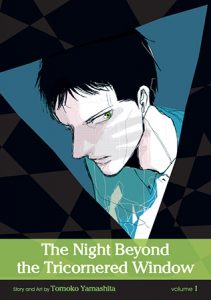 Until Olivia mentioned it over in the comments on Manga Bookshelf, I had no idea this series existed, let alone that it was being released in English! Having loved Yamashita’s Dining Bar Akira and Black-Winged Love, I immediately purchased all extant volumes.
Kosuke Mikado has been able to see spirits since he was a child, but any time he tried to talk to his friends about it, they thought he was weird, so he has been keeping his distance from other people and has begun to doubt his own sanity. When the manager of the bookshop where Mikado works hires Rihito Hiyakawa to deal with a pesky spirit—and after Hikayawa recognizes Mikado’s powers and uses them to boost his own—Mikado finally finds someone who lives in the same world he does. Although he begins the series frightened and clinging to skepticism, through Hiyakawa’s assurances, Mikado gradually accepts the things he sees as reality and begins to combat them independently.
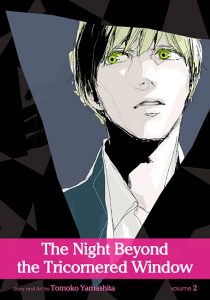 I love series like this, where the leads have episodic disturbances that they investigate (via the partnership they strike up as a sort of supernatural cleaning crew and frequently assisting a non-believing cop named Hanzawa) plus an ongoing mystery (involving curses cast by someone named Erika Hiura) and yet the most important and fascinating aspect is the relationship between the leads themselves. There are the fun, suggestive moments where the guys are combining their powers for one reason or another and end up using dialogue like, “Do you want me to touch it?” or “Take me all the way in.” But where Yamashita-sensei really excels is at teasing out threads of darkness.
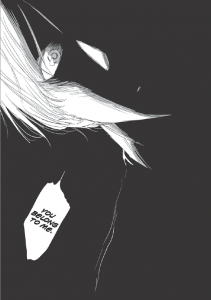
We first get an inkling that something is amiss when the guys visit a potentially fraudulent fortune-teller. Mikado is the one who physically sits for the session while Hiyakawa, bodily still in the waiting room, casually inhabits Mikado’s body to see for himself. The fortune-teller warns Mikado that the way Hiyakawa reaches into him so easily is dangerous, a warning neither Mikado nor I take seriously. And yet, after an encounter with Erika Hiura shows Mikado’s vulnerability to being accessed in this way, Hiyakawa makes Mikado enter into a contract he doesn’t remember, and we get this awesomely creepy full-page panel.
After this point, more and more potentially disturbing things about Hiyakawa are revealed. “I don’t have parents or friends,” he says at one point. Later, he seems baffled by the concepts of beauty and evil. As troubling indications mount, Mikado knows that he should be thinking seriously about what is happening between them. Other characters certainly question it, but Mikado is strangely reluctant. Is it because Hiyakawa is somehow keeping him quiescent, or is Mikado willfully maintaining his ignorance because he does not want to go back to being alone?
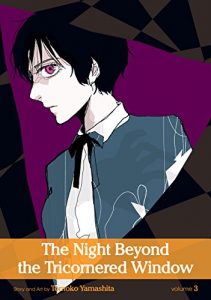 It’s only at the end of volume three, wherein Hiyakawa nonchalantly suggests that it’d be good if they could work the other side of the business, too, that Mikado realizes he has no idea what kind of person he’s working with. As a reader, I too was lulled into believing that of course the protagonist of a series about fighting the supernatural is a good guy. Turns out, he’s more of an empty-inside opportunist. At this point, even I just want to say, “Run away, Mikado! Run away and don’t look back!” Is there any hope that he can help heal and humanize Hiyakawa, or will he only end up destroyed? How soon until volume four comes out?!
Lest my focus on the relationship suggest otherwise, the plot of The Night Beyond the Tricornered Window is also excellent. In fact, I sincerely owe Olivia a debt of gratitude. And SuBLime, too, in fact. I hope print editions are available at some point in the future, because this is a series I need to have on my shelves.
The Night Beyond the Tricornered Window is available on Kindle and at sublimemanga.com. The series is ongoing in Japan, where the fourth volume has just been released.
Leave a Reply